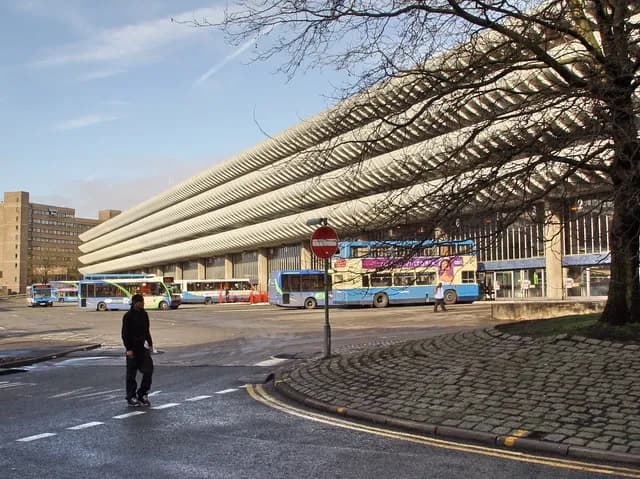
Preston Bus Station, the vast Brutalist landmark that dominates the city's western approach, was once scheduled for demolition. In 2012, Preston City Council voted to tear it down. Yet the building stands today, Grade II listed and freshly renovated, because local residents refused to let it disappear.
A Building Under Threat
Preston Bus Station opened on 22 October 1969, designed by Keith Ingham and Charles Wilson of Building Design Partnership with engineers Ove Arup & Partners. Built by John Laing Group, it was constructed to accommodate 80 double-decker buses alongside an 1,100-space multi-storey car park. The Twentieth Century Society later described it as "one of the most significant Brutalist buildings in the UK."
Despite its architectural significance, the station faced repeated rejection when campaigners sought listed status. English Heritage refused the first application in 2000, with Preston Borough Council opposing it. Further applications in January 2010 and April 2011 were also turned down.
The Demolition Vote
On 7 December 2012, Preston City Council announced the bus station would be demolished. The council's executive passed the proposal on 17 December 2012.
The financial case appeared stark. Council estimates put refurbishment costs at £23 million, with £5.4 million needed for essential repairs to lifts, ramps, and concrete. Annual running costs were £297,000. Demolition, by contrast, would cost just £1.8 million.
Councillor Matthew Brown, then cabinet member for community engagement and inclusion, warned that funding refurbishment would require a 24 per cent council tax rise. Councillor Robert Boswell, cabinet member for community and environment, supported the demolition decision in the hope it would attract alternative development funding.
Local Resistance Grows
The decision triggered a sustained campaign by Preston residents. John Wilson of Fulwood, a member of the "Save Preston Bus Station" group, presented a petition of 1,435 signatures to the council in February 2012, calling for a referendum on the station's future.
Wilson told the BBC that surveys indicated 80 per cent of Preston people supported keeping and investing in the station. "This building is an icon," he said. "It's unique in its design, it's part of Preston… you cannot just wipe it away."
Councillor Terry Cartwright, representing Deepdale ward, was the only councillor to vote in favour of holding a referendum.
The campaign gained national attention. In October 2011, the station was included on the World Monuments Fund's 2012 "Watch List" of sites at risk. The Twentieth Century Society ran an e-petition and publicly opposed the demolition, arguing that "a fraction" of the £1.8 million demolition cost would maintain the building while retention proposals were developed.
The Turning Point
The campaign achieved its breakthrough on 23 September 2013, when Preston Central Bus Station and Car Park was granted Grade II listed status. The listing made demolition virtually impossible and forced a reconsideration of the building's future.
In October 2014, Lancashire County Council announced £23 million renovation plans, including new "Youth Zone" facilities and a public square. An international design competition run by RIBA in 2015 attracted over 90 entries and more than 4,200 public votes. John Puttick Associates, with offices in New York and London, won the commission.
Refurbishment began in 2016. The station officially reopened in July 2018 following a £19 million facelift. A final phase constructing the public square on the western side was completed in late 2019.
From Threatened to Celebrated
The transformation was remarkable. In May 2019, the project won three RIBA North West awards: Regional Award, Conservation Award, and Client of the Year. It also received a RIBA National Award and was long-listed for the Stirling Prize.
Preston Bus Station now operates with 40 stands, reduced from its original 80 following the 2016 works. It remains a working bus station operated by Lancashire County Council, with the public square hosting cultural events including 50th anniversary celebrations in October 2019.
The campaign that began with a local petition and one dissenting councillor ultimately preserved what a 2010 Lancashire Evening Post survey had already confirmed: Preston Bus Station was, and remains, the city's favourite building.