The Dock That Bankrupted a City: How Preston Built Europe's Largest Inland Port in 1892
When Preston's Albert Edward Basin opened on 25 June 1892, it was celebrated as Europe's largest single inland dock. Yet the project that was meant to secure the city's industrial future became a financial millstone that burdened local ratepayers for more than six decades.
Victorian Ambition on the Ribble
The idea of a major dock for Preston had circulated since at least 1837, when the corporation commissioned civil engineer Robert Stevenson to develop plans for diverting the River Ribble. It took nearly half a century and several navigation acts before the Ribble Navigation and Preston Dock Act 1883 finally enabled construction to proceed.
The contract was awarded to Thomas A. Walker on 3 September 1884, with a tender of £456,600 11s. 2d. Walker was already renowned for major works including the Severn Tunnel and Barry Dock. The first sod was turned on 11 October 1884, and Albert Edward, Prince of Wales, laid the foundation stone on 17 July 1885.
The engineering was formidable. The basin measured 3,000 feet long by 600 feet wide, covering 42 acres with a quayside stretching 1.8 kilometres. Some five million cubic metres of earth were excavated to create a dock capable of holding vessels drawing up to 12 metres of water, situated nearly 26 kilometres from the Irish Sea.
Costs Spiral and Construction Stalls
The initial estimate of £500,000 proved woefully inadequate. By 1888, funds had run out and construction halted on 28 July. The project remained dormant for nearly two years until work resumed on 10 July 1890, but further tragedy struck when Thomas A. Walker died in November 1889. His executors, advised by Robert William Perks, were left to complete the scheme.
When the dock finally opened, the total cost had exceeded £1 million, more than double the original estimate. Preston Corporation was forced to take out a long mortgage that would not be fully repaid for over 60 years.
Opening Day and Early Trade
Alfred, Prince of Edinburgh, officiated at the opening ceremony on 25 June 1892. The royal steam yacht Aline was the first vessel to enter, whilst commercial traffic began with ships such as the SS Lady Louise and the cement carrier Hebe.
For a brief period, Preston appeared to have secured its place as a major Lancashire port. Booths and other local industries relied on the dock for imports and exports, and the dock branch railway, opened in 1846, connected the quayside to the national network.
Ninety Years of Struggle
Despite its impressive scale, the dock was profitable for only 17 of its 90 years in operation. The Ribble's shifting sands demanded constant dredging, and by 1975 this single expense consumed 45 per cent of the port's income. That year recorded an operating loss of £1.5 million, the largest in the port's history.
Trade peaked in 1968 at 2.5 million tons, but dockers' strikes in 1969 and 1970 disrupted ferry services, which were abandoned in the early 1970s. Annual losses between 1975 and 1979 ranged from £800,000 to £1 million. A report in September 1979 concluded there was "no future prospect for operating the port at a profit."
Closure and Redundancy
A phased closure was announced in 1976, though a reprieve followed when a £2 million grant was secured. The final decision came in October 1979. The last Preston-based ship, the dredger Hoveringham V, departed on 22 October 1981. The port formally closed on 31 October 1981, and 350 jobs were lost directly.
The physical legacy cost the city dearly as well. Sealing the dock and maintaining the site was estimated at £3.5 million over ten years. The industrial contamination left behind required clay-lined containment cells to manage hazardous residue.
From Working Dock to Riverside Leisure
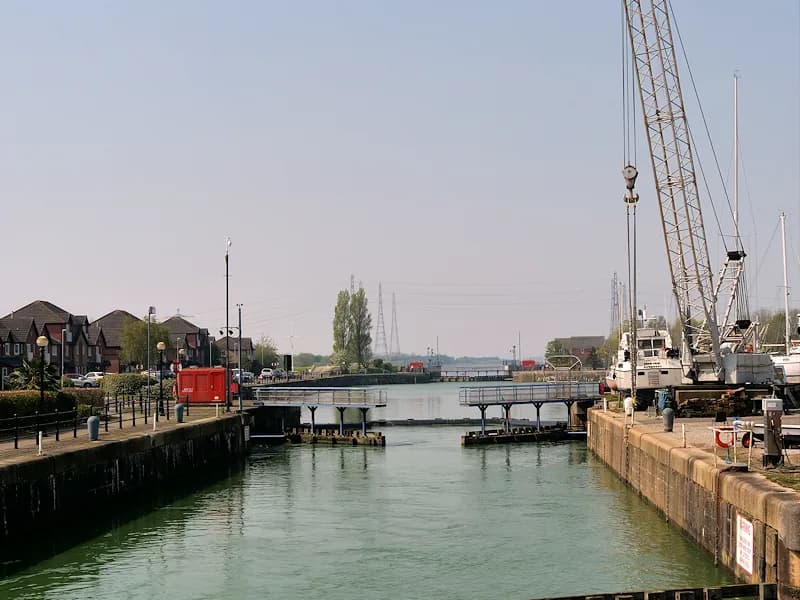
Redevelopment plans were selected in 1985, and by July 1987 the Preston Marina had opened on the former dock basin. The area was rebranded as Riversway, with new roads including Mariners Way, Navigation Way, and Port Way threading through industrial and residential zones. A 1,000-tonne swing bridge was installed across the entrance lock.
Of the original dock buildings, only a handful survived. Shed No. 3 was converted into Victoria Mansions, and the Customs House on Dock Road remains. The site has since generated more than 2,000 jobs, though this took decades to achieve.
In 2005, the Ribble Steam Railway opened on the former dock railway, offering heritage trips across the swing bridge. Yet the basin still reminds visitors of its industrial past; blue-green algae blooms continue to trouble the water, a lingering consequence of the dock's enclosed environment.
What Is Confirmed
The dock opened on 25 June 1892, cost more than £1 million, and was profitable for only 17 of its 90 years. The mortgage taken to fund construction was repaid over 60 years by ratepayers.
What Is Unclear
Specific details about how the 60-year mortgage was structured, and how ratepayers experienced the financial burden year-to-year, are not fully documented in available sources.